How to Organize 30 Years of Photos (Freebie: Getting Started Checklist)



Learning how to organize 30 years of photos feels impossible when your collection is everywhere at once — boxes of prints, thousands of phone images, old CDs, maybe inherited slides you haven’t touched in years. If you’ve pulled it all out and put it back without making a dent, you’re not failing. You just hit a wall of decisions you didn’t know how to make. Here’s how to break through.
This post may contain affiliate links, which means that I may receive a commission if you make a purchase using these links. As an Amazon Associate, I earn from qualifying purchases.
Do you have boxes of printed photos — maybe even inherited ones — alongside a phone full of images you’ve never sorted, old devices you can’t remember what’s on, and a nagging sense that the whole thing is way beyond fixing? You are not alone. A lifetime of photos in every format imaginable is genuinely a lot to take on. But I’m going to tell you something I’ve told hundreds of people over 20 years of helping families tackle exactly this: it is not too far gone, and you are not too late. Understanding how to organize old family photos can be daunting, but with the right approach, it can become a rewarding experience.
I’m Fancy, and I’ve been a professional photo manager since 2002. I’ve helped people organize collections far bigger and more chaotic than yours. Every single one of them started in the same place: overwhelmed, uncertain where to begin, and convinced their situation was the worst one I’d ever seen. It never was.
Let me help you get started.
The Problem with a Lifetime of Photos
The problem is never just the volume. It’s the variety.
Here’s what most people don’t realize: a photo collection doesn’t stay stuck because of time or technology. It stays stuck because of decisions.
When you don’t know which decision to make — keep or toss, organize first or digitize first, this software or that one — you freeze. And frozen is where collections live for years. Sometimes decades.
You’ve got printed photos from the film era — some in albums, some loose in envelopes, some stuffed into boxes you moved from house to house for decades. You’ve got digital photos on your current phone, probably your old phone too, and maybe a laptop or two with folders you set up years ago and never fully maintained. There may be slides or home movies you literally cannot view anymore without special equipment. And if you’re like a lot of the people I work with, you’ve also inherited a collection from a parent or grandparent that came to you all at once, unsorted, and full of faces you may not even be able to name.
All of that together is genuinely a lot. The overwhelm is not an exaggeration — it is a completely reasonable response to a complex, emotionally loaded project that no one ever taught you how to do.
Most people aren’t doing anything about their photo memories. When adult children clean out a parent’s home, they often throw away the boxes of unsorted, uncurated photo memories — not because they don’t care, but because they simply don’t know what to do with them. If you don’t make the time to tackle this now, it’s likely no one ever will. Ultimately, knowing how to organize 30 years of photos means preserving your legacy for future generations.
When I ask people what’s stopping them, I get the same two answers every time:
- They don’t have the time.
- They don’t know where to start.
Here’s some Photo Manager math for you:
No Time + No Knowledge = Overwhelm
Overwhelm is paralyzing. It feels like an elephant sitting on your chest. And how do you eat an elephant? One bite at a time.
Many people ask how to organize 30 years of photos to preserve their memories effectively. The solution lies in breaking it down into manageable steps.
Let’s take those two problems one at a time.
How to Organize 30 Years of Photos When You Don’t Have the Time
We are busy people. Busy days become busy weeks, busy weeks become busy years, and the photo project keeps getting pushed to the back of the line. We tell ourselves we’ll do it when life slows down, when the grandkids aren’t visiting, when the holidays are over, when we finally have a free weekend to really dig in.
Here’s the thing: that free weekend does not exist. And waiting for it is the most reliable way to ensure this never gets done.
If you can’t get started now, the honest truth is that you probably never will. And later, you may find yourself looking back on years of time that were spent waiting for the “right moment” — which, it turns out, was every single moment you kept setting aside.
There Is Good News
You don’t need a free weekend. You need a decision and a small chunk of recurring time.
Your photo mess didn’t get into its current condition overnight. It took years — probably decades — to accumulate. It won’t take that long to organize, but it will take consistent effort over time. That is not bad news. It means you can chip away at it in whatever increments fit your real life, and still make meaningful progress.
For some people that looks like 15 or 20 minutes a day while they have their morning coffee. For others it’s a couple of hours on Sunday afternoons — which is exactly what I did when I tackled my own collection. Some people prefer one Saturday a month. There is no right or wrong schedule. The only requirement is that it’s one you can actually keep.
Three Ways to Keep Your Commitment
First: Know your “why.” Who are you doing this for? Yourself? Your kids? A grandchild who isn’t old enough to ask questions yet but one day will? The clearer your reason, the easier it is to show up on the days you’d rather not. If you’re doing it for yourself, remind yourself that you are worth it — because you are.
Second: Put it on your calendar. Not as a vague intention, but as an actual appointment with yourself. Set an alarm. Block the time. Treat it like any other commitment. Because it is one.
Third: Tell someone. Committing to a change in habits is harder in isolation. Tell a friend, a sister, your daughter. You might even find someone who wants to work on their own collection alongside you — over Zoom or Facetime, checking in by phone or text, cheering each other on. You might even join a community of people doing the same thing. My free Facebook group is full of Family Photo Keepers who are right where you are — and cheering each other on. Community makes hard things more doable.
How to Organize 30 Years of Photos When You Don’t Know Where to Start
The hardest part of any big project is starting. But when the decisions feel endless and permanent, “just start” is not very helpful advice.
So here is the first step, as specifically as I can give it to you:
Decide you are going to do this.
Not “decide how.” Not “figure out the system.” Not “buy the software.” Just decide that you are going to do this, and that you are worth doing it for.
Commitment is the most important step, and it comes before every other step. Once it is genuinely in place, everything else becomes a matter of learning and practice — not willpower.
The hardest part of any big project is starting. But when the decisions feel endless and permanent, “just start” isn’t very helpful advice. As you begin learning how to organize 30 years of photos, take it one step at a time to avoid feeling overwhelmed.
So here is the first step, as specifically as I can give it to you:
Decide you are going to do this.
Not “decide how.” Not “figure out the system.” Not “buy the software.” Just decide that you are going to do this, and that you are worth doing it for.
Every decision you make while learning how to organize 30 years of photos matters and shapes your collection.
Here are the rest of the steps:
The Key Stages of Every Photo Management Project
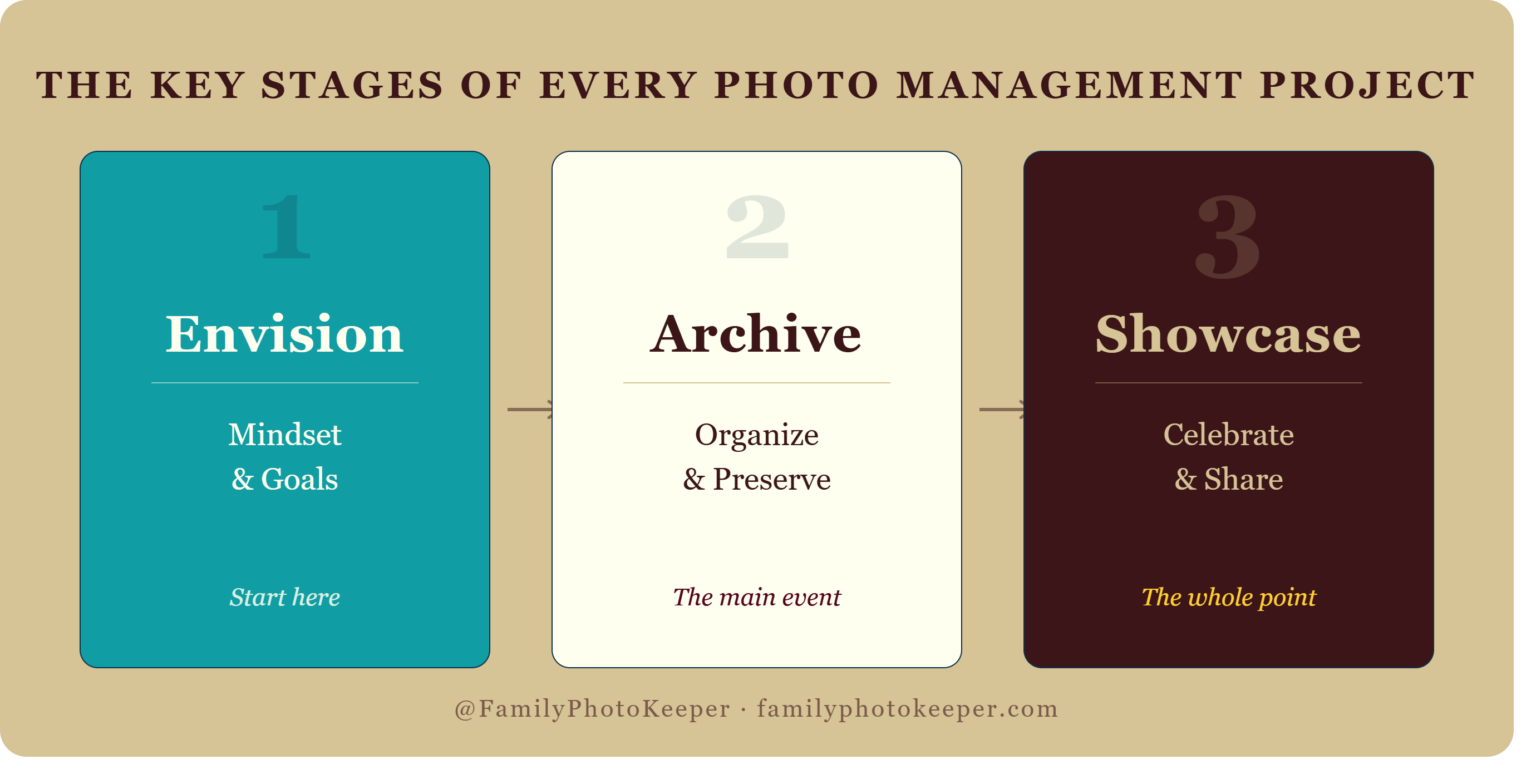
Every photo management project moves through three stages. They build on each other, and they always go in order.
Envision is where you start. Before you touch a single box or open a single folder, you get your mindset right and set your goals. This is the stage most people skip — and it’s exactly why they stall out two weeks in.
Archive is where the real work happens: sorting, digitizing, organizing, and preserving your collection in a system that actually makes sense. It takes time. That’s expected. One bite at a time.
Showcase is the whole point. Sharing photos with family. Creating a photo book that makes someone cry happy tears. Handing your kids a collection that says: I took care of this for you.
You won’t finish all three stages in a weekend — and you’re not supposed to. But every hour you put in moves you closer to a collection you can actually enjoy, and one day, confidently pass down. In this journey of how to organize 30 years of photos, remember that every small effort counts.
And you do not have to make this trip alone. When you join the Family Photo Keeper community, you get all the help you need along the way. When you finally learn how to organize 30 years of photos, it feels like a weight has been lifted off your shoulders.
What’s Next?
Your next step is to join the email community. As a welcome gift, I’ll send you my Getting Started Checklist — a practical, no-overwhelm guide to taking your very first steps with confidence. After that you’ll receive my weekly newsletter, packed with helpful tips, honest answers to common questions, and encouragement to keep going.
If you ever have a question, I’m never further than an email or a message away. I never share your information, and you can unsubscribe at any time.
Embrace the journey of how to organize 30 years of photos — it’s one worth taking.